
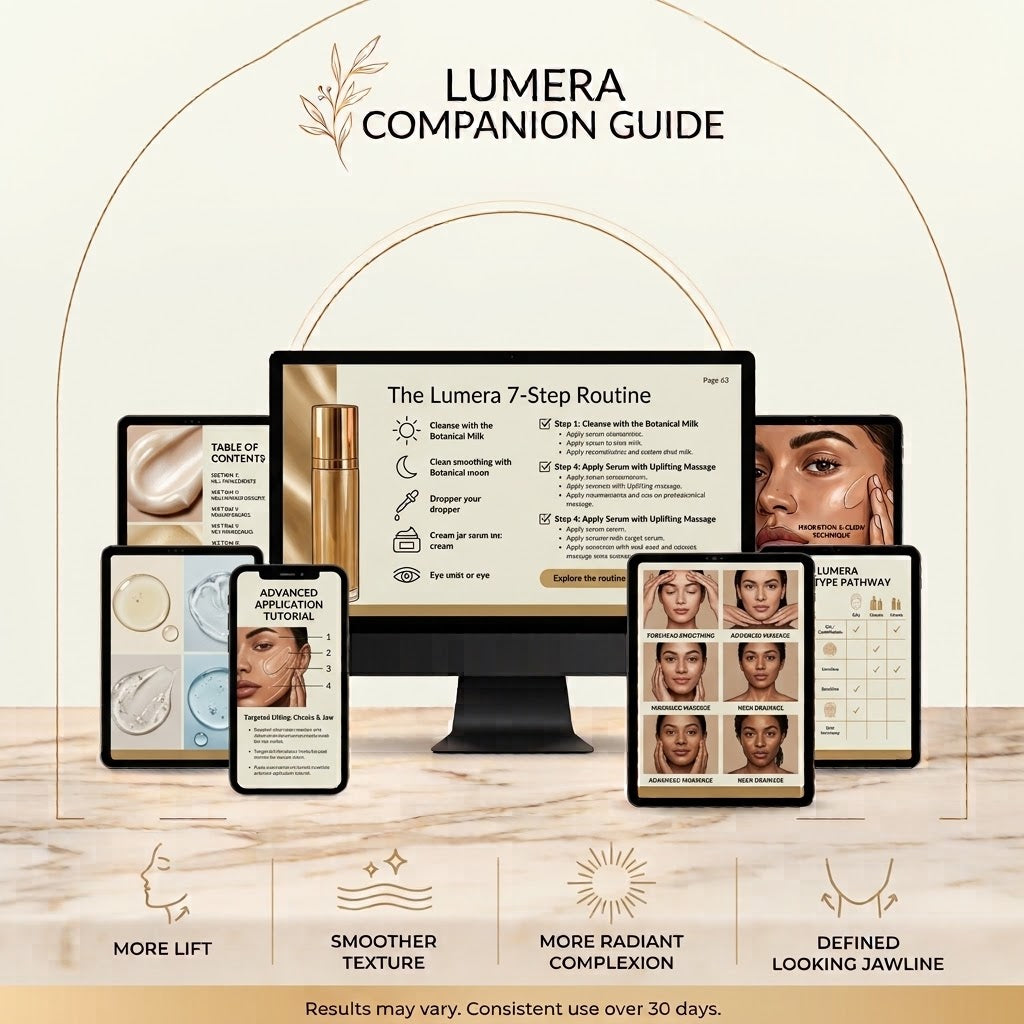
Your skin changed. Here's why.
Skin doesn't age on your birthday. It ages on your hormones — and that explains the speed, the breakouts, and why your friend the same age looks untouched.
An honest, evidence-ranked guide to perimenopausal skin: what's actually happening, the three things with real evidence, what's oversold, and a five-product routine built for skin that's become drier and more reactive at once.
- The four signs — and the one cause behind all of them
- What has real evidence, what's oversold, what to stop buying
- The five-product routine and the ninety-day plan
Educational guide, not medical advice. Every clinical figure is sourced.
Four changes, one cause.
They arrive together, or close to it — and they're strange enough that most women assume each one has a separate explanation. It doesn't.
Breakouts along the jaw — in a woman who never had them
Lower face, jawline, sometimes the neck. Often deep and tender, and very often in someone whose teenage skin was completely clear. This isn't adolescent acne arriving late.
Dryness your moisturiser can't touch
You apply it, and within an hour the skin feels as it did before. This isn't a moisture problem — it's a barrier problem, and adding water to the surface doesn't fix a barrier that no longer holds it.
Lines deepening faster than they should
Fine lines you'd made peace with become defined over months rather than years. The skin looks and feels thinner. The numbers behind this are startling — and they're in the next section.
Products you've used for years suddenly sting
The one nobody warns you about, and the one most likely to send you on an expensive, fruitless shopping trip. The answer is almost never a new product.
And you're somewhere between your late thirties and mid-fifties, this guide is describing your skin. That doesn't require a diagnosis, a test, or anyone's permission.
30%
of skin collagen, lost in the first five years after menopause
Brincat et al., Obstetrics & Gynecology, 1987
Skin ages on hormonal time, not chronological time.
The clock in that finding isn't your age — it's time since menopause. Two women born the same year can be nearly a decade apart on this curve. That's why generic advice for "women in their forties" is so unreliable, and why the guide asks where you are in the transition rather than how old you are.
Fourteen chapters, one afternoon.
Written to be read in order, and built to be opened at whichever chapter you need tonight.
A ranking, not a shopping list.
Three tiers, each with the reference attached. The guide spends as long on what to stop buying as on what to buy.
The three that matter
Get these right before adding anything.
- A retinoid. Improves wrinkling, pigmentation and texture from about four weeks, sustained to two years. Introduced slowly — slower than you would have at thirty.
- Daily SPF. The largest modifiable driver of collagen loss, and it matters more now that oestrogen-depleted skin has weaker antioxidant defences.
- Barrier support. Ceramides and hyaluronic acid on damp skin. The thing that makes the retinoid tolerable at all.
The honest middle
Real, but narrower than they're sold on.
- Collagen supplements. Real evidence for hydration, elasticity and barrier across 35 trials — and none for wrinkles, where the effect was a statistical artefact.
- Vitamin C, peptides. Reasonable additions once the core is stable. Not first, not instead.
- Home devices. Genuine, modest, and working on different layers of the face. Chapter ten separates what they can and can't reach.
Your money
Marketed hard to this exact buyer.
- Oestrogen face creams. One double-blind trial out of ten; unstudied systemic absorption; batch variability in compounded products. The guide explains why to wait.
- "Menopause skincare" ranges. Usually a good moisturiser with a different word on the front and a different price.
- Anything sold on fear. The collagen curve is real. It is also not an emergency, and nothing in this guide needs buying today.
 Chapter ten, in your hand
The guide tells you how to use a device. This is the one built to that spec.
Most people who buy a red light or microcurrent device use it wrong — wrong distance, wrong dose, and they quit at week three. Chapter ten explains the protocol. LUMÈRA is the red light and microcurrent device built around it.
“In a randomised, placebo-controlled trial, combined red and near-infrared light reduced wrinkles by up to 36% and improved skin elasticity by around 19%.”
Lee et al., Journal of Photochemistry and Photobiology B, 2007 — split-face, double-blinded, with tissue biopsies
- Red and near-infrared light for the skin layer — the collagen chapter
- Microcurrent for the muscle layer — the jawline chapter
- The dose, distance and twelve-week rules in the guide apply to it directly
Real, modest, gradual. Skin changes show at four to eight weeks; judge it at twelve. It doesn't lift structurally, treat medical conditions, or replace your retinoid and SPF — the guide says so, and so do we.
Disclosed, not buried.
This guide was produced by the team behind FabulousGoodz, who also make LUMÈRA. It says so on the last page — and it's why the guide states plainly what home devices can't do, including ours.
Every figure is sourced
Brincat 1987 on collagen. Lee 2007 on red light. The 2026 meta-analysis on collagen supplements. Check any number you doubt — that's the point of the book.
No brand paid for a mention
No product is named as best anywhere in it. Where a category is called oversold, that comes from the published evidence, with the reference attached.
It says what doesn't work
Including about our own device. A guide that flattered the category would be easier to sell and worth less to you.
Fair questions.
No. It's an educational guide. Two chapters discuss prescription options — hormone therapy and prescription acne treatment — so you can walk into an appointment informed, not so you can skip one. Those decisions belong to you and your doctor.
No. The guide stands on its own. The three things with the strongest evidence — a retinoid, daily SPF, barrier support — cost very little and are covered in full. Chapter ten covers home devices honestly, including what they can't do.
As a PDF, sent to your email straight after checkout. It reads on a phone, tablet, laptop or printed. 43 pages, with a tear-out one-page routine at the back.
Because this is a digital download you can read in full straight away, you agree at checkout to immediate delivery and waive the 14-day right of withdrawal. If the file doesn't arrive or won't open, email us and we'll fix it the same day.
Women between roughly their late thirties and mid-fifties who've noticed their skin change faster than "ageing" explains. If you recognise three of the four signs in chapter one, it's describing you.
Every clinical figure is referenced in the sources section at the back — the 1987 collagen study, the 2007 light trial, the 2026 collagen-supplement meta-analysis and the rest. Where the evidence is thin, the guide says so.
Nothing in here needs buying today.
The collagen curve is real. It's also not an emergency. Knowing what's happening is what makes the decision yours — which is the whole point of the book.